
Mon - Fri 7:00 - 17:00
32 fullarton dr Epping 3076 Australia
Posted by FPMBuildingSupplies
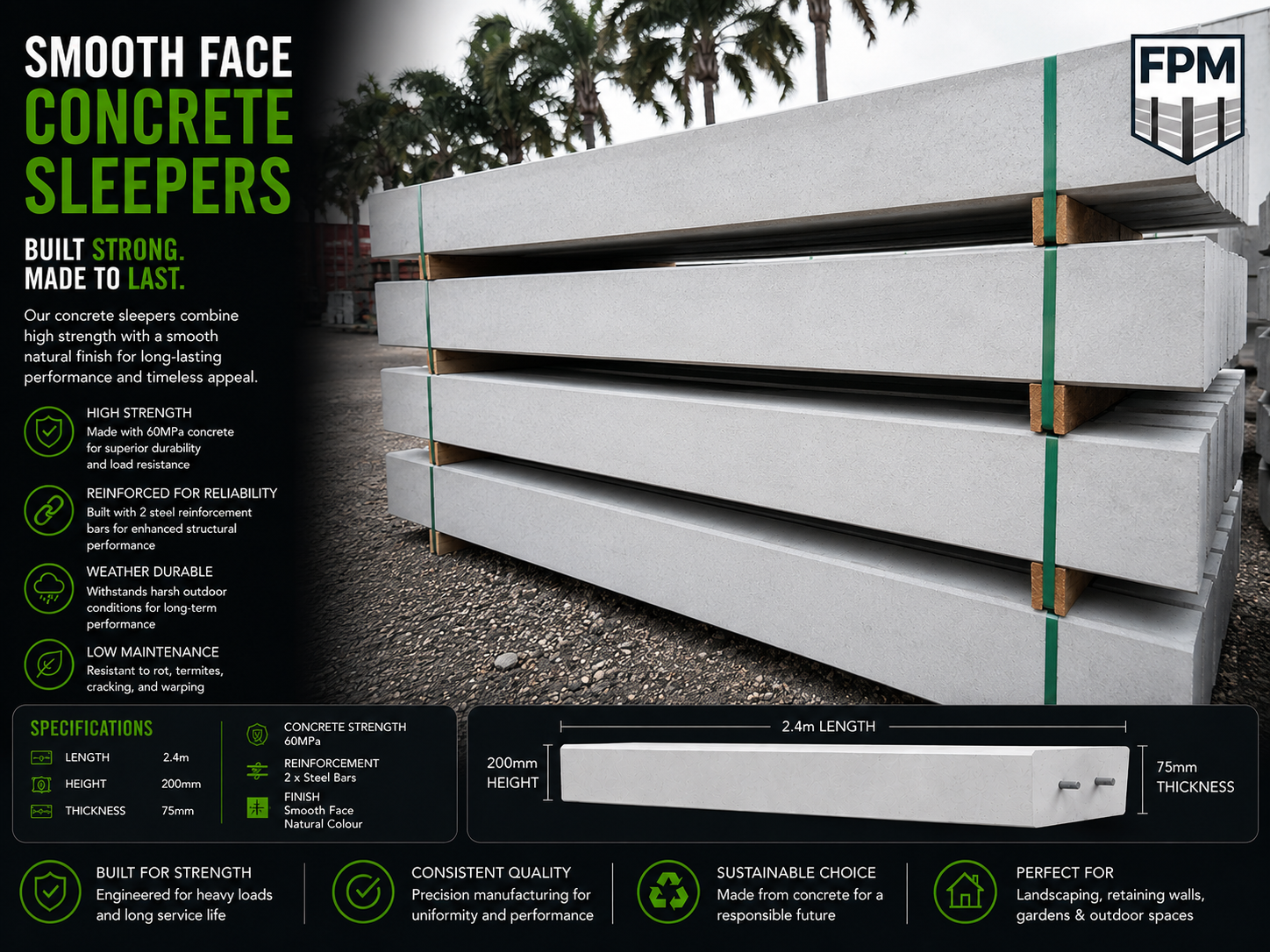
Concrete Sleepers: 60MPa Strength Explained

Concrete Sleepers: 60MPa Strength
Table of Contents
ToggleThe Backbone of Durable Retaining Walls: Why 60MPa Matters
In the world of civil and structural engineering, few specifications carry as much weight as compressive strength—particularly when it comes to concrete sleepers used in retaining walls, roadways, and landscaping projects across Victoria. A 60MPa (megapascals) rating isn’t just a number; it’s a benchmark of reliability, especially in regions like Epping and Wallan where reactive clay soils exert immense pressure on built structures. Concrete sleepers designed to meet this strength threshold offer superior resistance to cracking, deformation, and long-term wear, making them a go-to solution for engineers and contractors tackling challenging terrain.
High-strength concrete ensures enhanced load distribution and durability under sustained stress, a critical factor when constructing multi-tiered retaining systems or supporting elevated ground in residential and commercial developments. These sleepers maintain integrity in extreme weather and high-moisture environments, resisting spalling and chemical degradation over time. When paired with proper installation techniques—such as adequate base compaction, drainage integration, and correct post alignment—60MPa sleepers deliver decades of low-maintenance performance.
This guide dives into what 60MPa truly means, how it impacts real-world construction outcomes, and why choosing the right concrete strength is essential for safety, compliance, and project longevity in Victoria’s demanding soil conditions.
Understanding 60MPa Concrete Strength: How It Stacks Up in Retaining Wall Applications
When specifying concrete sleepers for retaining walls across Victoria’s reactive clay zones, compressive strength is a critical performance indicator—and 60MPa represents a high-tier standard in structural durability. But what does 60MPa actually mean? Put simply, it measures the concrete’s ability to withstand 60 megapascals of pressure per square meter before failing—a benchmark that exceeds many standard-grade sleepers used in residential and light commercial builds.
Common concrete grades for sleepers typically range from 32MPa to 40MPa, suitable for low-rise or non-structural uses. However, in high-load environments like sloped sites in Epping or Wallan, where lateral earth pressure and soil expansion are concerns, 60MPa concrete offers significantly enhanced resistance to cracking and deformation.
Key advantages of 60MPa over lower grades include:
- Greater structural integrity under heavy soil loads and dynamic ground movement
- Longer service life due to reduced micro-cracking and water ingress
- Improved performance in aggressive soil conditions, including high-moisture and saline environments
- Compliance with rigorous engineering specifications for walls exceeding 1.2 meters in height
Compared to 40MPa sleepers, 60MPa variants provide up to 50% higher load capacity, making them ideal for engineered retaining systems where safety and longevity are non-negotiable. For contractors working on sites with challenging geotechnical reports, selecting 60MPa concrete sleepers isn’t just a best practice—it’s a strategic decision that supports compliance, reduces maintenance risks, and enhances overall project resilience.
6 Unbeatable Benefits of 60MPa Concrete Sleepers for High-Performance Retaining Walls
When it comes to building resilient retaining walls in Victoria’s reactive clay zones, 60MPa concrete sleepers are engineered to deliver unmatched structural performance. Understanding their core advantages helps contractors and builders make informed decisions for long-term project success.
Exceptional Load-Bearing Capacity
60MPa concrete sleepers are specifically designed to handle high compressive stress, making them ideal for supporting significant earth pressure in elevated or sloped landscapes. Their superior strength ensures minimal deflection under load, even in demanding applications such as multi-tiered retaining systems in Epping or Wallan.Long-Term Durability in Harsh Conditions
Unlike timber or lower-grade concrete, 60MPa sleepers resist degradation from moisture, UV exposure, and soil movement. This resilience translates to decades of service life, especially in Victoria’s variable climate where wet seasons and clay expansion are common challenges.High Resistance to Cracking and Spalling
The dense mix design and controlled curing process of 60MPa concrete significantly reduce the risk of cracking. This structural integrity is critical in retaining walls where hairline fractures can lead to water ingress and progressive failure over time.Consistent Dimensional Accuracy
Manufactured to strict Australian Standards, these sleepers offer uniform size and shape, streamlining installation and ensuring tight, stable wall alignment. This precision reduces on-site adjustments and improves overall build efficiency.Low Maintenance and Repair Costs
Once installed correctly with proper drainage and support, 60MPa sleepers require minimal upkeep. Their resistance to biological and chemical deterioration eliminates the need for treatments or replacements associated with organic materials.Compliance with Engineering Specifications
Widely accepted in structural designs under AS 4678, 60MPa sleepers provide predictable performance that engineers trust. Their use supports faster approvals and confident compliance on both residential and commercial retaining wall projects across Victoria.
Installing 60MPa Concrete Sleepers: A Step-by-Step Guide for Structural Integrity
Achieving long-term stability in retaining walls and ground structures starts with precise installation of high-strength 60MPa concrete sleepers. Follow these steps to ensure compliance, safety, and optimal performance in challenging soil conditions across Victoria.
Assess Site Conditions and Prepare the Trench
Excavate to a depth of at least 300mm below the sleeper’s base level. Ensure trench width allows for proper drainage layers. In reactive clay soils common in Epping and Wallan, compact subsoil thoroughly and install a 150mm gravel base to prevent differential settlement.Lay Geotextile and Drainage Layer
Place geotextile fabric along trench walls before adding 200mm of crushed rock. Insert a perforated PVC drainage pipe at the base behind the intended sleeper location to manage hydrostatic pressure.Position Concrete Sleepers with Precision
Begin at the lowest point. Use a surveyor’s level to ensure each 60MPa sleeper is aligned to within 3mm. Stagger joints between rows and maintain a 10–15mm gap for expansion. Secure upper rows with steel tie bars embedded into lower units.Backfill and Compact in Stages
After each sleeper lift, backfill with granular material and compact in 150mm layers. Avoid using native soil if expansive.Inspect and Monitor
Check alignment daily during installation. In high-moisture zones, incorporate weep holes at 1.2m intervals.
Proper technique ensures your structure withstands Victoria’s variable weather and soil movement—delivering durable, code-compliant results every time.
Frequently Asked Questions About 60MPa Concrete Sleepers
What does 60MPa mean for concrete sleepers?
60MPa refers to the compressive strength of the concrete, meaning it can withstand 60 megapascals of pressure. This high strength is essential for structural integrity in retaining walls, especially in reactive clay soils common across Victoria. It ensures long-term resistance to cracking and shifting under heavy loads.
How long do 60MPa concrete sleepers last?
When properly installed, 60MPa concrete sleepers can last 50+ years with minimal degradation. Their durability exceeds timber and many alternative materials, making them ideal for permanent retaining wall solutions in both urban Epping lots and rural Wallan properties exposed to varying weather.
Do concrete sleepers require regular maintenance?
No routine maintenance is needed. Unlike timber, they won’t rot, warp, or attract termites. Occasional visual inspections for wall alignment and drainage clarity are recommended—particularly after extreme weather events—to ensure optimal performance over decades.
Are 60MPa sleepers compliant with Australian Standards?
Yes. These sleepers meet or exceed AS 4678 for earth-retaining structures and align with the National Construction Code. Engineers commonly specify 60MPa strength for load-bearing walls in challenging soil conditions found throughout Melbourne and regional Victoria.
Can they be used in coastal or high-moisture areas?
Absolutely. Concrete is inherently resistant to moisture damage, and the increased density at 60MPa further reduces permeability, making it well-suited for humid environments and coastal proximity where salt exposure and water saturation are concerns.
Is specialty equipment needed for installation?
Standard site machinery—including excavators and cranes—can handle 60MPa sleepers. Their predictable dimensions and weight allow for efficient placement, reducing onsite labor time and costs, especially when integrated with galvanised steel posts.
Why 60MPa Concrete Sleepers Stand Up to the Toughest Demands
When it comes to high-performance retaining walls and structural applications in Victoria’s challenging soil environments, 60MPa concrete sleepers consistently prove their worth. Their engineered strength makes them a go-to choice for projects requiring resilience against reactive clay, heavy lateral loads, and long-term exposure to fluctuating weather conditions—common concerns from Epping to Wallan and beyond. The high compressive strength ensures minimal deflection under pressure, reducing the risk of wall failure and maintenance issues over time. Unlike lower-grade alternatives, 60MPa sleepers maintain structural integrity across decades, offering a durable, low-maintenance solution for both residential landscaping and commercial earth retention systems.
For contractors, the value lies in predictability: standardised dimensions, compliance with AS 4678, and compatibility with galvanised steel post systems streamline installation and inspection processes. To move forward, assess your project’s load requirements and soil classification to confirm if 60MPa sleepers align with your engineering design. Consider consulting technical data sheets for installation best practices, especially around drainage and foundation prep.
Investing in proven, high-strength materials isn’t just about meeting code—it’s about building with confidence. Explore your local supplier options to ensure timely delivery and access to consistent-grade sleepers for your next job.